
Introduction: The Eight-Month Zipper Question
Tote bag zippers rarely fail with a dramatic snap. They wear down slowly. A nylon coil starts skipping teeth, or a metal track begins catching, corroding, and misaligning, usually after several months of steady use and often around the eight-month mark. The two designs get there by different routes, which is what makes them worth comparing under the same conditions.
The comparison below covers the three stresses a tote actually meets: rain, sand, and daily abrasion. It works from the mechanics and materials of each design, not from manufacturer claims.
Scope and Target Conditions of Use
This comparison narrows the broader question of tote bags with zippers to two types in standard tote configurations: a nylon coil zipper and a metal-tooth zipper. Both are considered under the same loads, opening cycles, and exposure.
Target conditions of use are realistic rather than laboratory-ideal:
- Wet commutes and intermittent rain exposure
- Coastal and desert sand contact
- Repeated daily open/close cycles under moderate loads (laptops, groceries, books)
How the Two Designs Are Compared
Marketing copy calls zippers “premium” or “heavy-duty” without defining either word. This comparison looks instead at the specific points where zippers fail: cycle counts, corrosion onset, debris buildup, and wear on the coil or teeth.
Four dimensions matter: construction, moisture behavior, grit tolerance, and long-term wear. Each is tracked over the same eight-month timeline for both types.
Why Month 8 Is the Durability Checkpoint
By eight months, a well-used tote has moved past new and into genuinely broken-in. Early novelty wear is gone, and the zipper has cycled enough times to show whether its design tolerates grit, moisture, and repeated loading. Failures that surface by then tend to be structural rather than incidental, which is what makes month 8 useful as a checkpoint.
Zipper Construction and Failure Mechanisms
A zipper is a load-bearing mechanism dressed up as trim. The two dominant architectures — the nylon coil zipper and the metal teeth zipper — store and transmit force in fundamentally different ways, so construction is where the comparison starts.
Material Composition
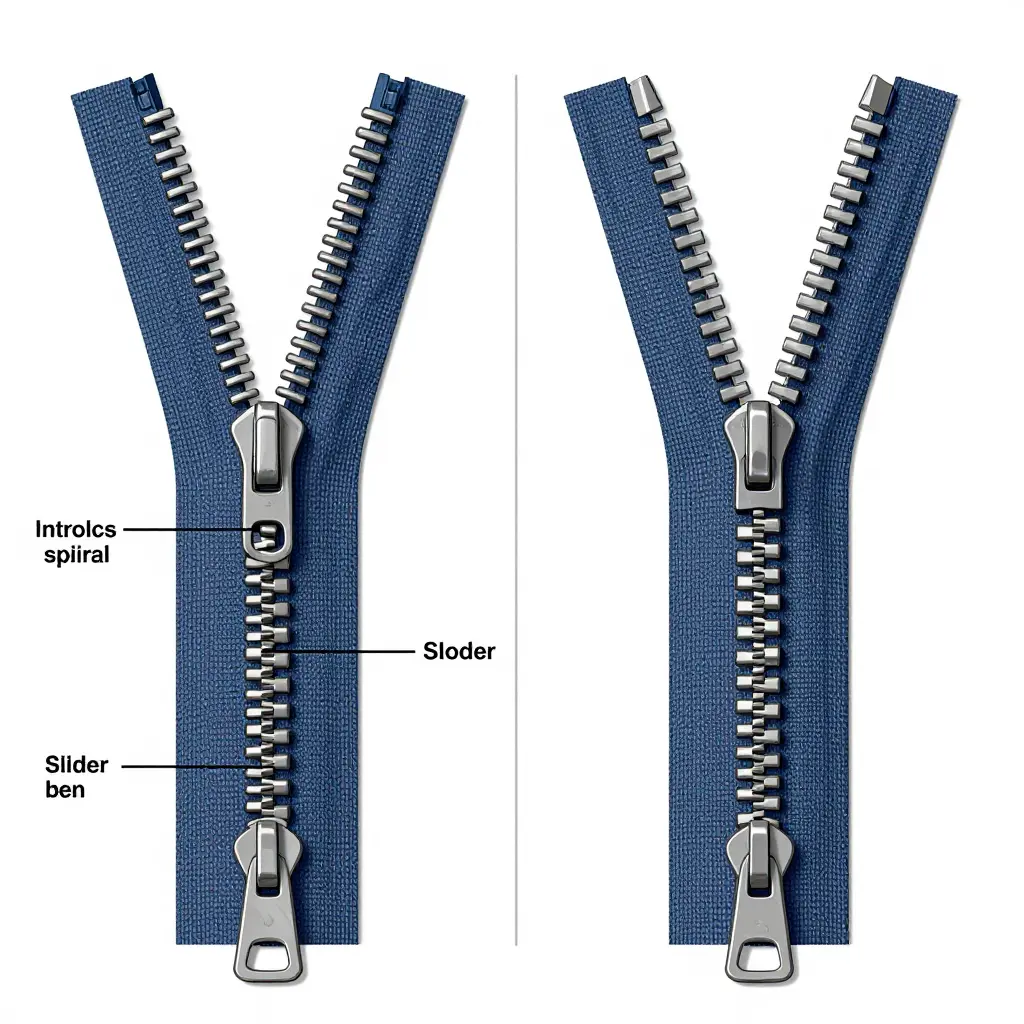
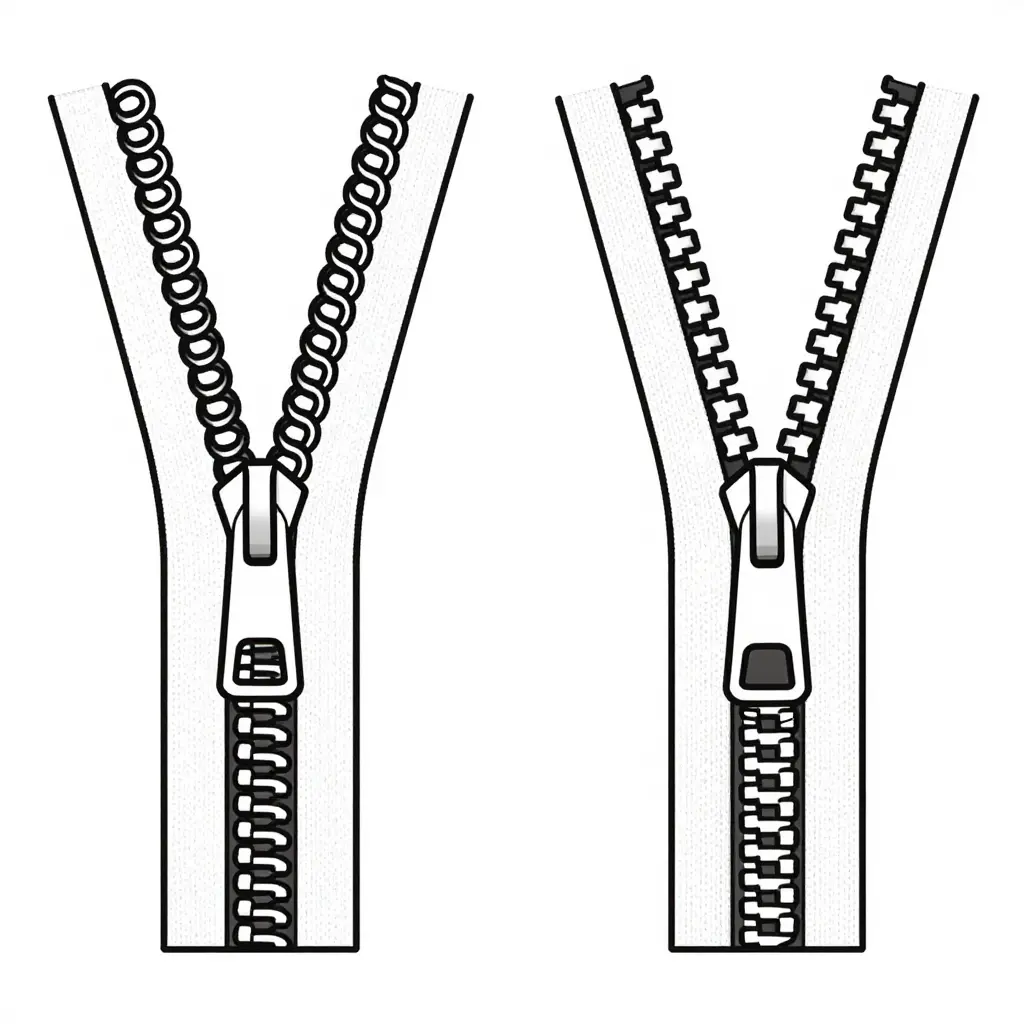
- Nylon coil: a continuous monofilament of nylon (polyamide, usually nylon 6,6) or acetal (POM) is extruded, coiled into a spiral, and heat-set so the loops keep their shape. The coil is sewn to woven fabric tape over a cord.
- Metal teeth: individual teeth are cast, stamped, or formed from zinc alloy, brass, or aluminum, then crimped onto the tape at fixed intervals to make a rigid chain.
Engagement Geometry
- The nylon coil closes through an interlocking spiral: opposing coils interleave, and a raised ridge seats into a matching groove.
- Metal closures use discrete interlocking teeth, each tooth mechanically capturing its counterpart. Alignment is positional and rigid rather than continuous.
Slider and Pull Mechanics
The slider is a wedge-shaped channel that converges the two stringers to close them and splits them to open. Internal cams force the elements into register, and the pull tab supplies leverage. On a coil, the slider rides over flexible loops; on metal, it indexes rigid teeth.
Top and Bottom Stops
The bottom stop fuses the stringers and caps slider travel, while the top stops keep the slider from running off the tape edge. Coil stops are molded or ultrasonically welded; metal stops are usually crimped or cast pins.
Failure Pathways by Architecture
Nylon Coil Zipper
- Deformation: repeated flexing erodes the heat-set memory, so loops flatten and misalign.
- Coil spread: sustained lateral stress widens the gap between loops, letting the slider separate coils under load.
- Failure is progressive and rarely catastrophic.
Metal Teeth Zipper
- Abrasive wear removes material from tooth crowns, loosening engagement until teeth slip.
- Oxidation and corrosion roughen surfaces, raising friction and the risk of seizure.
- Slider fatigue widens the slider channel until teeth no longer converge.
Why Failure Surfaces Around Month 8
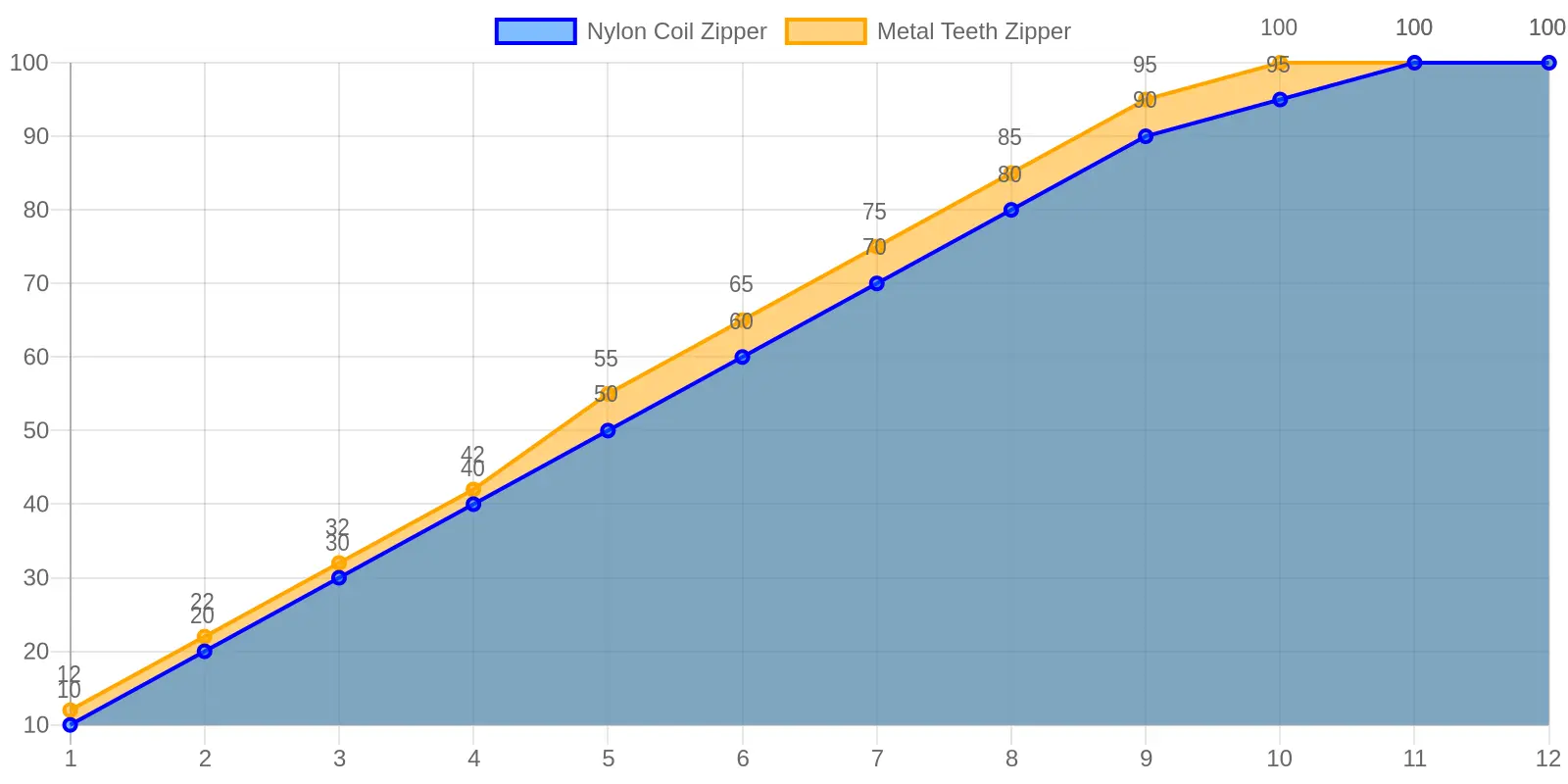
Every open-and-close cycle reverses the stress on the mechanism. Nylon gradually loses elasticity while metal accumulates wear and oxidation. Both reach the point where they no longer close cleanly after a similar number of cycles, which for daily use tends to land near month 8.
| Attribute | Nylon Coil Zipper | Metal Teeth Zipper |
|---|---|---|
| Element | Molded polyamide monofilament | Die-cast zinc or brass teeth |
| Engagement | Interlocking spiral | Interlocking discrete teeth |
| Primary failure | Deformation and coil spread | Abrasive wear and oxidation |
| Secondary failure | Slider gap widening | Slider fatigue and corrosion |
| Failure character | Progressive, gradual | Abrupt, seizure-prone |
Different tote bags with zippers balance these trade-offs in different ways.
Rain and Moisture Performance Analysis
Prolonged rain stresses a zipper in ways a splash does not. When a tote stays soaked for hours, water works into parts of zippered tote bags that rarely get inspected until they jam. Nylon coil and metal teeth respond in different ways.
Nylon Coil: The Tape Holds the Water
A nylon coil is a continuous polymer spiral stitched to woven fabric tape. In rain the tape behaves like a sponge: fibers pull water into their gaps, the tape swells, and because the coil sits under stitching tension, that swelling adds pull resistance. A slider that glides when dry can feel draggy and stiff once saturated. The enclosed gaps between loops trap droplets too, so drying is slow — often hours in humid, still air. The coil itself will not rust, but the wet tape is where a coil zipper stiffens.
Metal Teeth: Corrosion Inside the Mechanism
Corrosion is the slower and more damaging problem for metal. Zinc-alloy teeth oxidize readily, shedding white or gray powder and dulling the finish; brass develops a green-brown tarnish. The discoloration is mostly cosmetic. The real damage is galling, where oxidized, roughened surfaces grind against each other and the slider. Every wet cycle strips a little lubricant, and bare metal-on-metal contact speeds up material loss.
Sand Turns Moisture Into an Abrasive
Dry sand is already abrasive; wet sand is worse. Water glues grit into the coil gaps and between teeth, turning the zipper into a lapping tool that scours surfaces with every open. On metal, trapped damp sand holds moisture against the teeth and extends the corrosion window. On nylon, grit embeds in the softened tape and abrades both fabric and filament.
Drying, Stiffness, and the Month-8 Curve
Nylon dries slowly but recovers almost completely once dry. Metal dries faster but never fully resets: cumulative oxidation and lubrication loss leave it stiffer for good. Repeated wet-dry cycling compounds the wear. By the eight-month mark, nylon coil zippers show steady stiffness growth from tape fatigue and lubrication loss, while metal teeth hold function longer before corrosion drives a sharper jump in pull resistance. Neither is waterproof; both need occasional cleaning, drying, and re-lubrication to stay usable.
Nylon Coil vs. Metal Teeth Zipper: Comparison at Month 8
| Criteria | Nylon Coil Zipper | Metal Teeth Zipper |
|---|---|---|
| Material and construction | Continuous nylon coil sewn to fabric tape | Individual metal teeth (brass, aluminum, or nickel) crimped to tape |
| Weight | Lightweight; adds minimal heft | Heavier; metal hardware adds noticeable weight |
| Moisture/corrosion resistance | Excellent; nylon cannot rust | Poor to moderate; ferrous parts corrode, brass resists better |
| Sand and grit tolerance | High; flexible coil sheds grit and keeps sliding | Low; grit jams between rigid teeth |
| Abrasion resistance | Good; coil flexes under load | High on teeth, but plating wears off over time |
| Repairability | Moderate; slider swaps easy, re-threading coil is hard | High; teeth and sliders individually replaceable |
| Pull-slider smoothness over time | Stays smooth; self-lubricating nylon glides | Degrades; friction and oxidation stiffen travel |
| Typical failure mode under stress | Coil separation or slider gap opening | Tooth loss, bent teeth, or slider breakage |
| Rough cost tier | Budget to mid | Mid to premium |
| Expected condition at month 8 | Functional; minor tape fray possible | Variable; stiff or corroded in wet, sandy use |
Month-8 Durability: Nylon Coil vs Metal Teeth Across Stress Conditions
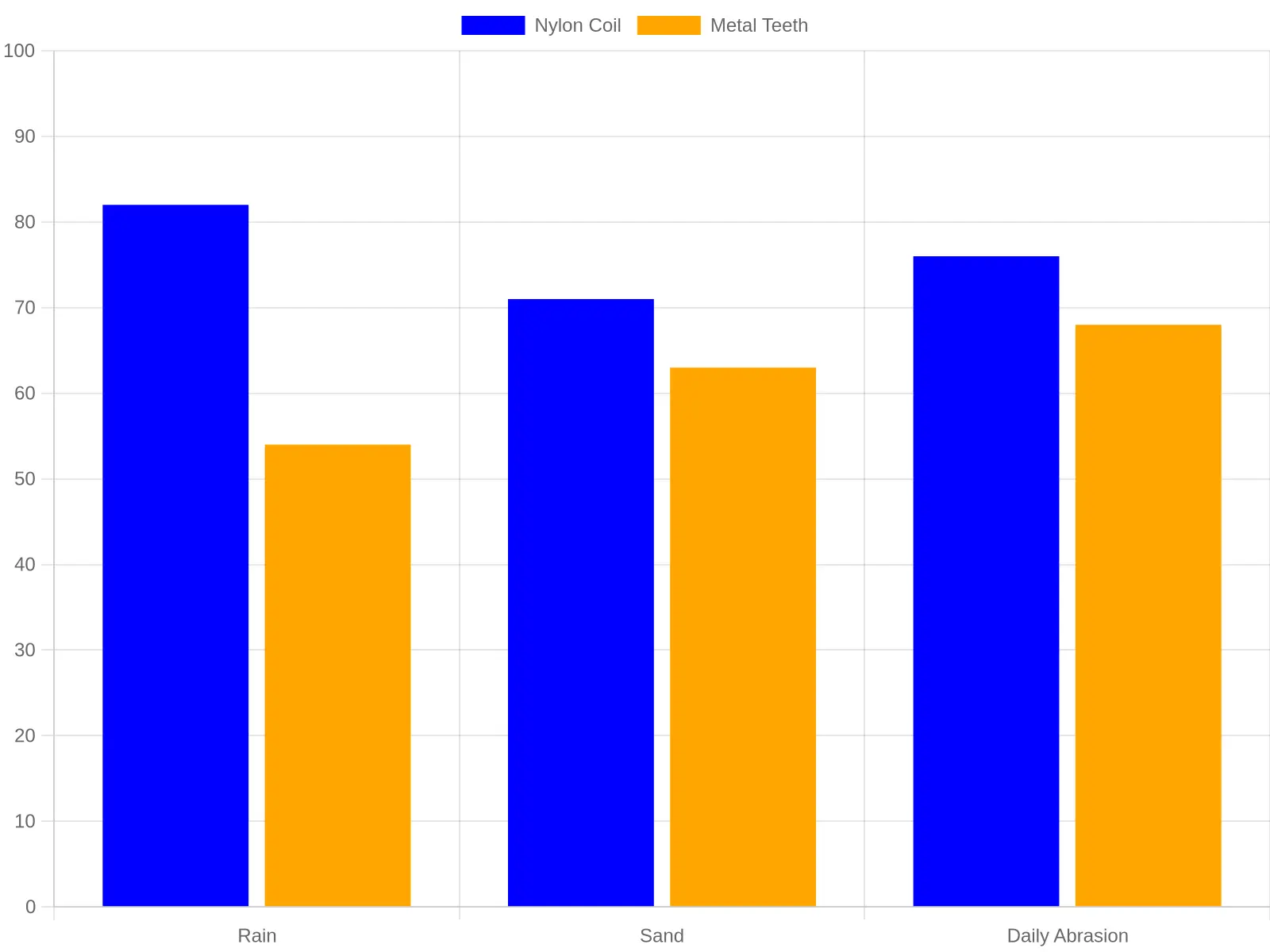
The chart plots a durability retention score (0–100, higher is better) for each zipper type after eight months under each condition. Grouped bars sit side by side so the degradation gap is easy to see.
| Stress Condition | Nylon Coil (Retention) | Metal Teeth (Retention) | Gap | Which Degrades More |
|---|---|---|---|---|
| Rain | 82 | 54 | 28 | Metal Teeth |
| Sand | 71 | 63 | 8 | Metal Teeth |
| Daily Abrasion | 76 | 68 | 8 | Metal Teeth |
What the Numbers Tell Us
- Rain is the decisive failure mode for metal teeth. A retention score of 54 against nylon coil’s 82 is a 28-point collapse driven by corrosion and seized sliders. If you carry a tote through wet commutes, this is the condition that ends a metal zipper’s life first. For weather resistance, look at tote bags with zippers built around coil hardware.
- Sand narrows the gap but does not flip the winner. Grit abrades both mechanisms, yet nylon coil still holds an 8-point lead, because a flexible coil tolerates embedded particles better than rigid interlocking teeth.
- Daily abrasion is the closest contest. Constant use wears the top coating on both, but nylon’s 76 stays ahead of metal’s 68, which suggests routine cycling favors the more forgiving, self-aligning coil.
Across all three conditions, metal teeth degrade more, and rain produces the widest divergence. For long-term reliability, nylon coil comes out ahead at the eight-month mark.
Common Zipper Failure Modes to Check
These failure modes show up in roughly the same order on either a nylon coil or a metal-tooth track, so they work as a checklist during any tote bag zipper inspection.
- Coil separation or spreading – Under lateral stress, adjacent nylon coil elements deform and pull apart, leaving a visible gap that the slider can no longer close.
- Metal tooth wear and oxidation – Repeated friction flattens metal teeth and exposes them to moisture, so rust and pitting roughen the interlock and weaken the seal.
- Slider loosening – The slider’s internal channel widens with use, so it stops compressing the teeth or coil tightly, letting the track pop open under load.
- Top-stop breakage – The molded or crimped top-stop cracks off, allowing the slider to run off the tape end and stranding the zipper open.
- Tape delamination about the coil – The tape separating from the coil shifts tooth alignment and creates a gap that continuously snags the slider.
- Grit-driven jamming – Sand and fine debris lodge between the teeth or coil, grinding the interlock and causing the slider to seize mid-track.
Month-8 Inspection Checklist
- Run the slider end to end twice and listen for grinding or binding.
- Inspect the coil or teeth under bright light for spreading, flattening, or oxidation.
- Pinch the closed track and tug gently to test slider compression.
- Check the top-stop and slider ends for cracks or missing material.
- Look for tape delamination near the coil at high-stress points.
- Brush the track clean and confirm the slider glides freely.
For tracks built to survive this wear cycle, see our range of zippered tote bags.
Daily Abrasion and Long-Term Wear: The First 8 Months
After eight months of regular use, a tote zipper rarely fails in a single moment. Thousands of small mechanical events slowly turn a tight, crisp track into a loose and unreliable one. Knowing where that wear lands tells you whether to repair the bag or replace it.
The open-close cycle is the real test
A commuter who opens a tote four times a day racks up roughly 1,000 cycles in eight months; a traveler or parent can exceed 3,000. Each cycle asks the slider to interlock or separate teeth, and each pass contributes to daily abrasion at the interfaces. Most of this early loss is invisible. It shows up as a slightly heavier pull, not visible damage.
Where the wear actually lands
Three failure points dominate by month eight:
- Tape-edge fraying. The woven fabric tape beside the teeth frays where the slider body scrapes it on every pass. Frayed tape loosens tooth alignment, which is often mistaken for a broken zipper.
- Coil fatigue versus surface wear. A nylon coil deforms elastically and recovers; over tens of thousands of cycles it can take a permanent set — true zipper fatigue. Metal teeth do not bend easily but gradually lose their plating, exposing edges that catch.
- Pull and slider friction. The pull and slider accumulate grit and oxidized residue, which raises the force needed to move them and accelerates the other two problems.
Load, lateral stress, and concentrated force
A fully loaded tote changes the physics. Weight pulls the two zipper tapes apart laterally, so the slider has to separate teeth that are being forced together — a concentrated load that stretches the tape and widens the track. This is why one heavy load can age a zipper faster than many light ones.
Nylon coil versus metal teeth
The two designs respond differently to high-cycle wear under light load and to concentrated stress:
| Factor | Nylon Coil | Metal Teeth |
|---|---|---|
| Deformation mode | Elastic bending, gradual fatigue | Surface abrasion, plating loss |
| Best at | High-cycle, low-stress use | Occasional, heavy-load use |
| Weak point | Permanent coil set, tape fray | Metal-on-metal grinding, grit |
| 8-month outlook | Even, predictable wear | Stable, then accelerated late-stage wear |
Nylon coil resists high-cycle, low-stress repetition because each segment flexes and returns, spreading stress across a continuous element. Metal teeth hold their shape under concentrated load but wear through surface contact, so grit and constant cycling erode them faster once the plating is gone. For a bag opened dozens of times a day, the coil’s flexibility usually wins; for infrequent but heavily loaded trips, the metal’s stiffness holds.
If you are shopping with longevity in mind, prioritize zipper-equipped totes with a taped-edge guard and a slider rated for repeated use. Those two features slow the wear curve more than any premium tooth material.
Month 8 Evidence Synthesis: Reading the Results Together
After eight months, the two designs stop looking interchangeable. Their differences are small at first and only become measurable once wear, moisture, and grit have accumulated. By this stage, “month 8 zipper failure” describes a recognizable pattern of decline rather than a single random break.
In rain, nylon coil tends to underperform. The woven tape and coil absorb moisture, swell slightly, and stiffen, which raises the force needed to move the slider. Metal teeth avoid that softening but corrode along exposed edges, adding drag and roughening the track. Coil stiffens; metal corrodes. Neither is a clean win in constant wet.
In sand, grit is the equalizer. Fine particles lodge between teeth and coil loops, and both designs suffer. Metal teeth clear grit more readily, but abrasive particles trapped against a hard slider wear the metal faster over repeated cycles. Metal tolerates jamming better; coil wears more slowly.
Under daily abrasion, the split narrows. Nylon coil deforms quietly and can lose alignment, while metal teeth stay dimensionally stable but grind against the slider and thin it over thousands of cycles. Everyday use favors metal’s stability, at the cost of slider wear.
Synthesis at a glance
| Condition | Nylon Coil Behavior | Metal Teeth Behavior | Tends to Hold Up Better |
|---|---|---|---|
| Rain / moisture | Swells, stiffens, higher slider force | Edge corrosion, added drag | Condition-dependent; metal in light exposure, neither under constant wet |
| Sand / grit | Grit lodges in coil gaps | Clears grit but abrades faster | Metal for jamming, coil for long-run smoothness |
| Daily abrasion | Coil deforms, may misalign | Dimensionally stable, slider thins | Metal, with the slider as the weak point |
No single design wins across the board. The trade-offs depend on conditions, so the useful move is matching the zipper to how you actually use the bag — wet commutes, sandy travel, or heavy daily carry — rather than assuming one material is tougher. Our guide tote bags with zippers shows how these patterns play out in real builds.
Selection and Maintenance Guidance
How to Choose Tote Bag Zipper Hardware
Match the closure to the environment, not the price tag. Two systems dominate the market, and they do not fail the same way.
Nylon coil zippers flex with the fabric, tolerate repeated bending, and shed small grit from the track. Metal teeth resist surface abrasion and hold their shape under load, but they corrode in rain and trap sand between individual elements.
| Criterion | Nylon Coil | Metal Teeth |
|---|---|---|
| Wet climates | Strong – corrosion-resistant polymer | Weak – rust and oxidation |
| Sandy environments | Good – coil sheds grit | Poor – sand jams teeth |
| High daily cycles | Good – low bending fatigue | Fair – teeth and puller wear |
| Abrasion resistance | Moderate | High |
| Field repair | Moderate – slider swaps easily, re-threading coil is hard | Moderate – teeth and sliders replaceable, but shop work |
For commuters logging many open-close cycles each day, a nylon coil on a laptop tote bag tends to outlast metal at month 8. In dry, low-cycle, heavy-load use, metal teeth on zippered tote bags can be the stronger choice.
Maintenance That Extends Life Past Month 8
Zipper maintenance is simple, and timing matters. Most zippers die of neglect rather than bad hardware.
- Clean grit: brush the track with a soft toothbrush every few weeks. Sand and lint grind both coil and teeth.
- Dry thoroughly: after rain, open the zipper fully and air-dry before storing. Trapped moisture accelerates metal corrosion.
- Lubricate appropriately: paraffin wax or silicone on nylon coil; dry graphite or a metal-specific lubricant on metal teeth. Avoid oil, which attracts grit.
Canvas bodies collect dust that migrates into the closure, so canvas tote bag owners should brush the zipper and seams together. Check slider tension monthly; a loose slider spreads the coil or teeth and causes misalignment long before total failure.
FAQ: Tote Bag Zipper Failure at Month 8
Why do nylon coil zippers fail around month 8?
A nylon coil zipper relies on a continuous spiral of polymer teeth that flex with every open-and-close cycle, and that repeated stress gradually deforms the coil. By month 8, a daily user has typically logged thousands of cycles, enough for the coil to stretch, gap, or separate along the slider path. Abrasion from grit trapped between the coils accelerates the wear regardless of how heavily the bag is loaded. The result is a zipper that no longer meshes cleanly and starts to pop open.
Are metal teeth zippers better in rain?
Not usually. Nylon coil zippers avoid the corrosion problem entirely because the polymer cannot rust, though the tape absorbs water and the zipper stiffens while wet. Metal teeth resist that stiffening, but zinc and brass corrode once the finish wears through, and saltwater or coastal rain speeds it up. Stainless or nickel-plated teeth hold up best, at a cost in weight and price. For wet or travel use, the metal-versus-coil choice often comes down to whether you would rather deal with stiffness or corrosion. If you are comparing tote bags with zippers, that trade-off is usually the deciding factor.
How does sand damage a zipper?
Sand acts as an abrasive between the teeth or coils, grinding the contact surfaces with every cycle. In a nylon coil zipper, fine grains lodge inside the spiral and pry the elements apart; in metal teeth models, grit accelerates wear on the slider and can cause jamming. Even a small amount of trapped sand measurably shortens service life over months of daily use. Regular flushing with fresh water is the most effective countermeasure.
Can a failed zipper be repaired or replaced?
Many early cases of tote bag zipper failure can be fixed rather than rebuilt. A qualified tailor can often squeeze a loose slider back to shape, realign separated coils, or replace just the slider at low cost. When the coil or teeth are physically broken, full replacement is necessary, which usually means removing the old tape and stitching in a new length-matched zipper. Because labor can approach the cost of a mid-tier bag, weigh repair against replacement before committing.
Does daily use or heavy loading cause faster zipper failure?
Both contribute, but through different mechanisms. Daily use accumulates flex cycles that fatigue a nylon coil over time, while heavy loading concentrates lateral force on the slider and teeth, which promotes deformation and gaping under stress. Combine frequent cycling with consistent overloading and a zipper can fail well before the 8-month mark. Matching the zipper gauge to the expected load is the most reliable way to extend its life.
The Verdict: Nylon Coil vs. Metal Teeth at Eight Months
At the eight-month mark, the comparison resolves into a practical, unglamorous pattern. Rain separates the two most sharply, but grit exposure and load decide most everyday cases.
Nylon coil zippers shrug off rain and humidity without corroding, and their flexible teeth tolerate light sand and constant flexing. Their limits appear under heavy grit and repeated stuffing: the coil edges abrade, and tote bag zipper failure usually begins as a slow separation or a skipped tooth rather than a sudden snap.
Metal teeth hold their shape and deliver crisp, dependable closure under high daily abrasion and heavy loads. In wet, salty, or road-salt conditions, though, oxidation and grit jamming accelerate wear, and deformed teeth cost more to repair.
| Condition | Nylon Coil | Metal Teeth |
|---|---|---|
| Rain / humidity | Strong – no rust | Weak – corrosion risk |
| Sand / grit | Good – resists light grit | Fair – grit jams teeth |
| Daily abrasion | Fair – edges wear | Strong – holds shape |
Which Type Suits Which Use Case
- Wet, humid, or coastal climates: nylon coil, for its reliable corrosion resistance.
- Dry, gritty, high-abrasion settings: metal teeth, when loads stay moderate and care is consistent.
- Mixed everyday commuting: nylon coil remains the safer all-round choice for consistent zipper durability.
Three factors decide the outcome: climate, grit exposure, and usage intensity. Maintenance matters as much as the starting spec. Rinsing away grit, drying hardware, and lightly lubricating teeth extend either type well past the eight-month mark.
Before buying, judge zipper quality directly by checking the coil or teeth gauge, the slider fit, and the tape stitching rather than trusting a brand name. Reviewing how tote bags with zippers are constructed helps separate durable hardware from decorative trim. That inspection, not marketing copy, is the most reliable predictor of long-term closure performance.