
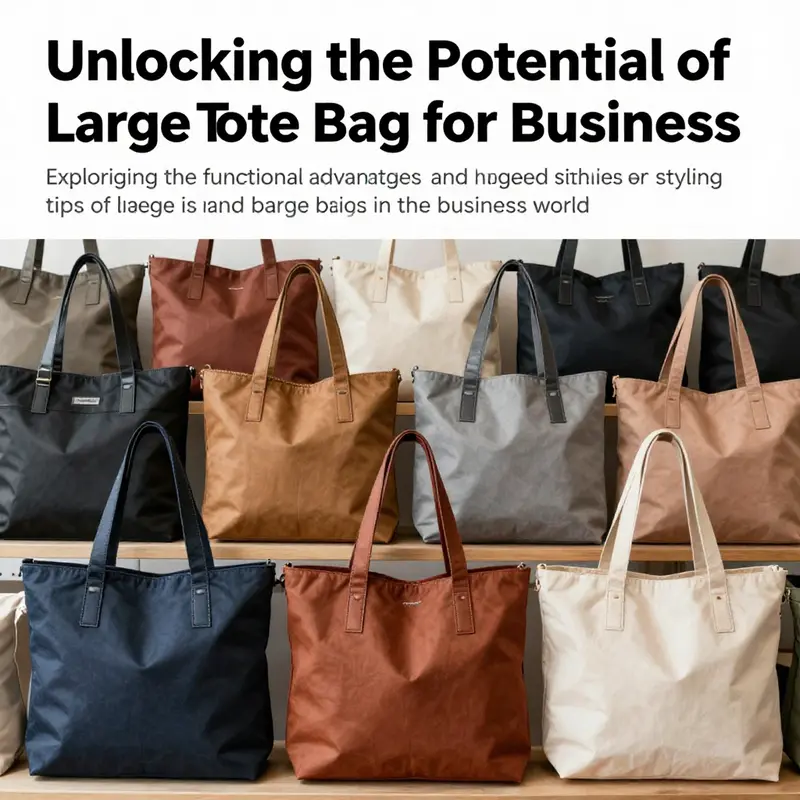
In today’s competitive business landscape, the efficiency and adaptability of everyday accessories can make a significant difference. Large tote bags have evolved from simple shopping aids to essential tools for professionals. This article aims to delve into the core characteristics and practical value of large tote bags, their capacity and design structure, and the styling tips that will help business owners select and utilize these versatile bags effectively. The forthcoming chapters will provide insights to enhance your understanding of how large tote bags can streamline operations, enhance productivity, and keep your brand stylishly on point.
Carrying Purpose: The Core Features and Everyday Value of the Large Tote Bag

A large tote bag is more than a container; it is a portable working surface, a buffer against the chaos of daily life, and a quiet statement about how we move through the world. In its generous opening and straight, practical silhouette, the tote invites us to pack with intention and to carry with ease. What begins as a simple open-top bag has evolved into a multifunctional companion that adapts to work, study, parenting, and travel. The larger tote is not merely about more space; it is about how space is organized, protected, and accessed in moments of need. When you stand in a corridor between meetings, with a laptop, a notebook, a water bottle, and a sweater spilling over the top, the tote’s design reveals its philosophy: practical accessibility without sacrificing order, elegance, or durability. The appeal is not just in what it holds, but in how it holds it together, in the way the bag maintains its shape and dignity even as it grows heavier with the day’s demands. The large tote therefore becomes a microcosm of modern living—open, adaptable, and relentlessly functional, yet capable of remaining stylish amid the friction of everyday use.
To understand why a large tote feels indispensable, it helps to start with its core characteristics. The most obvious feature is ultra-large capacity. This is a bag designed to “fit” more than the average daily carry, with a main compartment that can swallow a laptop, several files, a thick textbook or three, a water bottle, a compact umbrella, a light jacket, and perhaps a small cosmetic or tech kit. The typical dimensions—roughly 13 to 16 inches in width and about 12 to 14 inches in height—provide a frame that accommodates a 13-inch laptop and still allows room for a few personal items. In practical terms, this means a tote can replace a separate laptop sleeve, a briefcase, or a secondary tote for errands. It becomes a portable mini-station, a mobile desk and a changing room all in one. The sensation of carrying a tote is not just about space; it is about the ease with which that space is accessed. A wide, unencumbered top margin makes it effortless to reach a notebook beside a water bottle without opening the entire bag, while a flat bottom keeps the bag stable when it’s set down or when items are pulled from the interior without tipping over. The large tote’s capacity thus translates into real-time efficiency: fewer trips to the car, fewer bags to juggle, and fewer moments of rummaging through a crowded interior to locate a charger or a lipstick.
But capacity alone does not define the tote’s usefulness. The second pillar is a carefully organized interior. Modern iterations of the large tote emphasize that big space should not be an invitation to chaos. Many models feature internal dividers, padded sleeves, and zippered pockets that protect valuables and create zones for documents, electronics, and personal care items. A dedicated laptop sleeve is a common and welcome feature, offering a soft, cushioned pocket that shields devices from minor bumps and scratches while the bag remains comfortable to carry. For those who travel light but still require a from-work-to-weekend versatility, compartments that can be collapsed or expanded, as well as compression panels, allow the bag to adapt to the day’s shifting needs. Waterproof or water-resistant fabrics add a protective layer, ensuring that rain, spills, or damp environments do not compromise the contents. Some totes even fold into a compact pouch when not in use, turning a daily carry into a space-saving travel companion for weekends away or business trips. The design emphasis is clear: the bag should hold a lot, but not at the expense of order or protection.
Materials also play a defining role in how a large tote performs over time. The genre has embraced a spectrum of materials—from sturdy canvas and robust cotton to supple leather and high-tech synthetics. Durable canvas can handle heavy loads and resist rough treatment, while leather brings a sense of structure and resilience that ages gracefully with use. Synthetics and nylon blends offer a balance of weight, water resistance, and easy maintenance, appealing to those who value practicality in wetter climates or who anticipate frequent travel. The choice of material influences feel and weight, which in turn affects how a bag sits against the body during wear. A tote that is too heavy when empty can feel burdensome after a long day; conversely, a bag that remains stiff and structured as it fills can maintain a flattering silhouette, contributing to a balanced overall look. The modern tote, then, is a careful negotiation between capacity, rigidity, and weight—designed to be both dependable and adaptable in the long run.
The large tote’s versatility is reinforced by its carry options. The typical strap configuration includes long handles that allow shoulder or arm carrying as well as longer, adjustable straps for cross-body or messenger-style use. This flexibility makes the tote suitable for different outfits, occasions, and physical builds. For people who navigate crowded streets, public transit, or busy airports, the ability to switch between hand-held, shoulder, and cross-body modes can relieve shoulder strain and adapt to changing spaces. The option to adjust strap length means that the same bag can complement both a tailored office ensemble and a casual weekend look, preserving proportion and line. The visual logic is deliberate: a well-proportioned tote should harmonize with the wearer’s frame. When the bag hangs at the side, the bottom should ideally sit between the hip and mid-thigh to preserve an elegant silhouette. This guideline is not a rigid rule but a practical touchstone, reminding us that the bag’s size should elevate rather than overwhelm the wearer’s body. The aim is an overall balance where the bag’s horizontal presence aligns with the wearer’s vertical line, a subtle but essential component of style that becomes more noticeable as the bag fills with items.
Beyond capacity and structure, the large tote embodies a broader philosophy of modern practicality. It is the embodiment of a hands-free, all-seasons readiness—a tote that can function as a portable workspace, a family carryall, or a compact travel kit. For the commuter who leaves home with a notebook, charger, lunch, gym clothes, and perhaps a book for the bus ride, the tote consolidates everything into one accessible package. For a student balancing books, a laptop, a water bottle, and a planner, the bag becomes a reliable study buddy on campus pathways and library corridors. For parents navigating errands, a tote can integrate a change of clothes, wipes, snacks, and toys into a single, easy-to-carry unit. In travel, the bag transforms into a carry-on-friendly vessel for a change of clothes, a toiletry kit, an essential travel document set, and a compact electronics bag. The common thread across these roles is not merely volume but the sense of competence that comes with preparation and organization. The tote’s interior architecture—pockets, sleeves, and dividers—helps create a rhythm of retrieval: the charger goes to the sleeve, the passport to a discreet pocket, the umbrella to a side pocket, and the notebook to a central, accessible space. This rhythm is the quiet engine of efficiency that makes the tote feel like an extension of the wearer’s own planning and priorities.
The aesthetics of the large tote also deserve attention because this is a bag that often travels between different social contexts. The silhouette tends to favor clean lines, a rectangular or slightly rounded profile, and a flat bottom that supports its upright stance when loaded. While volume is a strength, proportion matters. A bag that is structurally rigid helps maintain a neat shape when it carries heavy or uneven loads, preventing the interior from collapsing and muting accessibility. A bag with a soft, slouchy body can exude a relaxed vibe, but it may sacrifice some form stability, requiring more careful arrangement of contents. Designers frequently balance these preferences by refining hardware, edge coatings, and stitching, all of which contribute to a sense of durability and quality that endures through daily use. Even with casual fabrics, details such as reinforced corners, secure closures, and low-profile linings translate into longevity. The result is a tote that remains presentable in professional settings, yet versatile enough for weekend markets, weekend trips, or spontaneous day trips to the coast.
As a result of these integrated design choices, the large tote becomes more than a bag; it represents a philosophy of capability. It invites its owner to segment the day into stages—work tasks, personal errands, and leisure moments—without constantly switching bags or reorganizing belongings. The phrase “mobile office” often appears in discussions about large totes not because the bag is a literal desk, but because its layout fosters a workflow: document folders are protected and accessible, devices are shielded without being buried, and a water bottle remains within easy reach for hydration during a long day. The tote thus serves as a compact, portable solution to the perennial challenge of carrying enough but not too much: enough space to avoid cramming, and enough organization to avoid digging. It is a careful compromise that reflects a broader transformation in how people approach space and time—an ongoing negotiation between the desire for abundance and the need for order.
In this sense, the large tote aligns with evolving design conversations that emphasize versatility, longevity, and a certain restraint. It is not about chasing every possible feature but about curating a set of core capabilities that cover the majority of daily scenarios. The bag’s ability to transition across environments—office, classroom, playground, and bus stop—speaks to a cultural impulse toward streamlined efficiency without sacrificing personality. A tote that can adapt to different clothes, different weather, and different tasks becomes a reliable partner rather than a collection of separate pockets for separate moments. And this adaptability often relies on a thoughtful balance between structure and softness: the tote must hold its shape enough to convey order, yet remain forgiving enough to accommodate unexpected items: a last-minute garment, a snack bag, or a spare umbrella. In this balance lies the practical truth about large totes: they succeed not only when they hold a lot, but when they help the owner hold the day together with clarity and ease.
To those who study the evolution of bag design, the large tote appears as a natural step in the journey toward more effective everyday carry. It is an acknowledgment that urban life demands more from a single piece of luggage than simply capacity. It requires a design that respects the wearer’s time, bodies, and routines. The tote’s enduring appeal stems from its ability to merge utility with a sense of calm composure. It communicates through its form and function that carrying heavy loads can be managed with dignity, not drama. The result is a bag that looks as composed when it is empty as when it is filled, a feature that makes it a reliable element in any wardrobe. For readers who want to explore how these ideas translate into current designs, there is a snapshot of ongoing conversations in tote design available here: tote-bags-trending. This reference captures how designers, brands, and wearers alike are interpreting space, proportion, and convenience in ways that resonate with contemporary life.
The large tote’s practical intelligence also has social and cultural resonance. It sits at the intersection of work-life balance, consumer pragmatism, and fashion versatility. It signals a shift from the era of specialized, single-purpose carry to a more inclusive approach to daily gear—where one bag can serve many roles, replacing several items that previously lived in separate spaces. This simplification is not a step backward; it is a deliberate adaptation to how people move through the day: meeting rooms, classrooms, grocery aisles, gym spaces, and train platforms. In this sense, the tote becomes a compact microcosm of urban adaptability, a repository that holds the day’s textures and textures of life—documents, devices, commitments, and even the small pleasures that accompany a routine. The bag invites a more thoughtful consumption pattern as well: it rewards quality in materials, construction, and design choices that withstand wear and weather while maintaining a calm, confident look. It is not about showing off abundance; it is about enabling readiness and ease, a quiet assertion that efficiency can exist alongside style.
As the chapter closes on its practical core, it is useful to consider care. The large tote benefits from regular cleaning, mindful storage, and a respect for weight distribution. A heavy bag that is well-maintained will retain its shape and function longer. Light daily maintenance—emptying the bag, wiping with a damp cloth, and occasional conditioning of leather components—protects the interior from wear and the exterior from the elements. When not in use, some users prefer to stuff the bag with a soft fabric to preserve its geometry, while others appreciate foldable options that minimize space and avoid creases. The right storage and care practices contribute to a tote’s longevity and its continued capability to carry the user through a variety of contexts without losing its form or function. In other words, a well-cared-for tote remains a stable platform for daily life, a dependable partner who understands that the day often demands more than one bag can deliver, and that one well-designed bag can meet that demand with quiet resilience. The large tote, in this sense, is a practical philosophy made tangible—a simple, durable, and stylish tool that makes everyday life a little more manageable and a little more enjoyable. For readers curious about how contemporary tote design threads trend insight into everyday carry, a concise look at current trajectories can be found here: tote-bags-trending.
External resource for further reading: https://www.163.com/dy/article/UMN7PQ0C05148FJZ.html
容量的艺术与结构的灵魂:大型托特包在现代出行中的高效装载

在日常的走动与短途出行之间,大型托特包的价值从来不仅仅在于“能装多少”。容量与设计结构像两条互相依存的线,一同编织出一个在忙碌城市生活中真实可用的核心物件。它看似简单,实则承载了对场景理解的深度,对人体工学的细致考量,以及对日常效率的执着追求。理解这两者的关系,就是理解这类包袋为何能在许多人的生活里成为不可或缺的“高效工作区”。大型托特包的容量和设计结构并非孤立存在,它们相互作用、互为因果,最终将“多用途”转化为“随手可得的便捷”。当你轻触包面,能感到容量的张力;当你打开内部结构,能体会到组织的秩序。最关键的是,这种秩序不是为了让物品更齐整,而是为了让携带者的日常运作更高效、思路更清晰。容量是物理的底座,结构则是到达目标的路网。二者结合,才能真正实现“当袋子挂于身侧时,底部位置应落在髋部到大腿中部之间”的视觉与使用平衡。这种平衡不仅关乎美学比例,更关乎穿着体验与工作流的连贯性。
null

null
Final thoughts
Large tote bags are not just a practical solution for carrying items; they embody efficiency, style, and versatility essential for today’s business owners. By understanding their core features, capacity, design, and complementary fashion tips, you can elevate your workday efficiency while making a fashionable statement. Investing in a quality large tote bag can streamline your daily activities and enhance your professional image, making them invaluable tools for success in your business journey.