
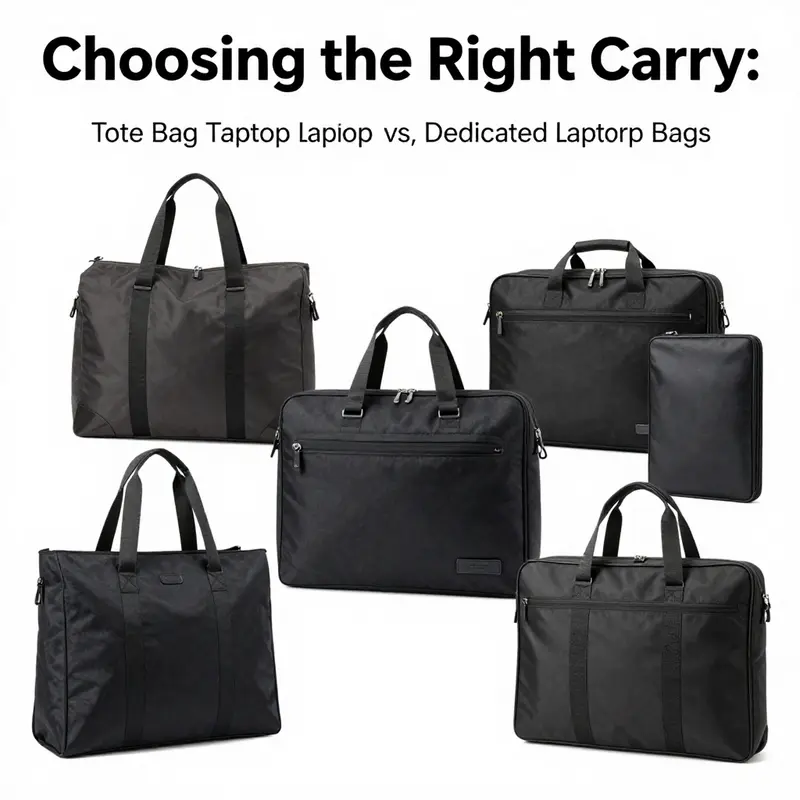
In today’s digital landscape, where laptops are essential for business operations, choosing the right way to transport your device can significantly influence its longevity. Business owners face a pivotal decision: should they opt for the stylish convenience of a tote bag with a laptop sleeve, or select the robust protection of a dedicated laptop bag? Each choice has its advantages and limitations, affecting the safety of your device during transit. This article delves into the contrasting features of tote bags with built-in sleeves and dedicated laptop bags, highlighting their protective capabilities, usage scenarios, and ultimately helping you determine which option aligns best with your business requirements.
Between Style and Shield: The Tote-Bag Laptop Sleeve in Everyday Mobility
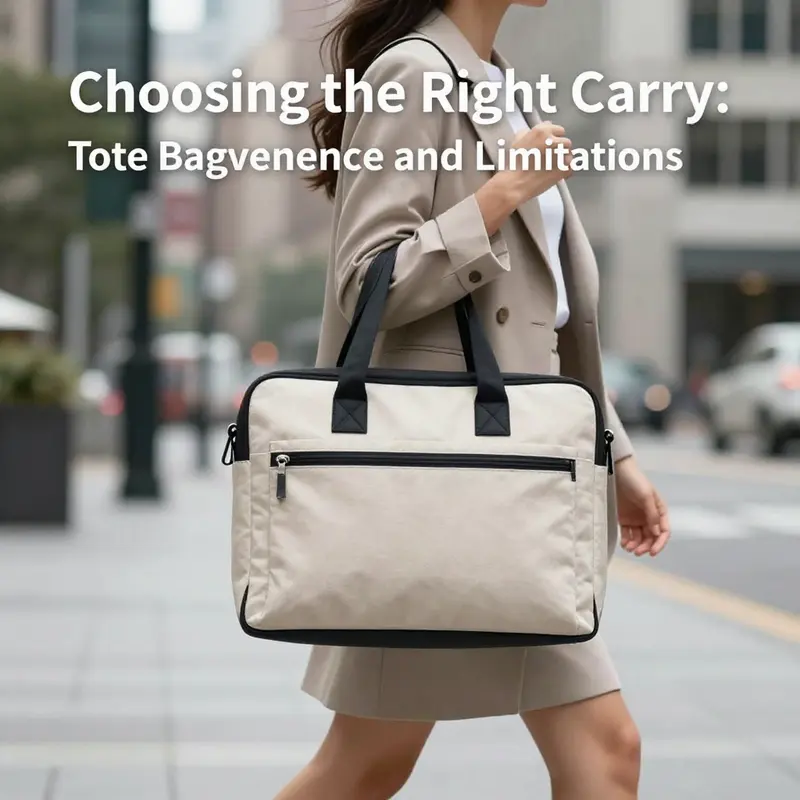
The tote bag with a built-in laptop sleeve sits at a curious crossroads. It is designed for the exchange between fashion and function, a handy compromise for people who want their device to ride alongside them through a full day of meetings, coffees, and quick errands without the burden of a heavier, more protective case. In a world where mobility has become a daily ritual, the tote-bag laptop sleeve embodies a practical elegance: it is simple to sling over a shoulder, easy to access during a quick hallway transition, and capable of presenting a professional silhouette that blends with both tailored attire and casual wear. Yet this elegance comes with a crucial caveat. Convenience does not always align with the kind of robust protection that a device can depend on when the street, the train car, and the office elevator all throw a little chaos into the itinerary. The very design that makes a tote bag with a laptop sleeve appealing—the single, streamlined exterior, the soft lines, the absence of bulky compartments—also undercuts its ability to absorb shocks, distribute weight evenly, and defend against the weather and the occasional squashed moment on a crowded shelf or a hurried escalator. Reading the landscape of daily life through the lens of device safety, one can see how this seemingly modest choice plays out in real-world scenarios: the bag might cradle a laptop securely enough for a light commute, yet it is far less prepared than a purpose-built laptop bag to cope with the unexpected tumbles, the heavier items, or the pressure from crowded urban transit.
A tote bag with a laptop sleeve is typically built around a single, spacious compartment that houses a dedicated padded pocket designed to keep the device buffer-stuffed away from the rest of the contents. This padding—often thin, around 5 millimeters on each side in many mainstream examples—serves as a modest shield against minor bumps and scratches. It is enough to prevent a scratch from a stray pen or a light nudge from a laptop charger, but it does not reliably cushion the device from impact. When the bag is placed on a floor, tucked under a seat, or stacked beneath heavier objects, that little cushion is easily compressed. In a crowded train or subway car, where bags clash, shift, and press against one another, the laptop can be pressed into an awkward angle or subjected to force concentrated at a single point. The risk is not merely cosmetic; pressures from stacking can subtly deform a chassis or accumulate micro-stresses across the casing that may shorten the device’s long-term lifespan. The minimal interior padding, while sufficient for daily errands, does not offer the true shock absorption necessary to withstand the pulsations of constant movement or the occasional accidental drop.
From an ergonomic standpoint, the convenience of a tote with a sleeve is often tied to carrying one strap or a single shoulder. This mode of transport is efficient in the moment but can be taxing over time. When weight is carried predominantly on one side, the body compensates with micro-adjustments in posture. These adjustments, repeated day after day, can lead to localized tension in the shoulder, neck, and upper back. The result is not a dramatic turnkey complaint but a phenomenon that emerges gradually: a sense of fatigue after a long day, stiffness in the neck, or a tension headache that seems to fold into the routine of commuting. The design pressures that create a lean, elegant silhouette—lightweight materials, slim profiles, and the absence of heavy padding—are precisely the conditions that invite this uneven weight distribution. The toll is most felt by those who travel frequently, carry more than just a laptop, or navigate unpredictable urban environments where hands are full, and bags are pressed against hips and ribs during a scramble to exit a train or board a bus.
The environmental shield provided by a tote bag with a sleeve is another area where the limitations are evident. Tote construction often prioritizes aesthetics and affordability, with materials like canvas, soft leather, or synthetic fabrics that convey a certain polish but may not be weatherproof. Unless the bag is explicitly designed with weather-resistant exteriors or watertight closures, moisture and dust can invade the interior through zippers, seams, or gaps between the sleeve and the outer fabric. Even when the padded sleeve offers some cushioning, moisture can reach the laptop from above or through the bottom of the tote if the exterior does not seal well. In damp conditions, a tote may behave more like a conduit for moisture than a fortress against it. In contrast, dedicated laptop bags are frequently engineered with crush-resistant zones, structured compartments, and water-repellent exteriors to create a more coherent defensive system around the device. The environment is not just about rain or humidity. In transit, dust and grit can find their way into the interior, accumulating in the gaps between the sleeve and the laptop, or between the laptop and the bag’s lining. Over time, this debris can contribute to abrasion along the laptop’s edges, and it can complicate hardware ports or ventilation vents if dust migrates into the device itself.
Yet there is a strong and undeniable appeal to the tote-laptop pairing. It embodies a certain spirit of modern work life: a portable, adaptable, almost you-could-have-been-somebody’s-briefcase-but-now-its-a-sling-bag. The aesthetic is intentional, signaling efficiency and readiness. Professionals who move between a conference room and a coffee shop, or who hop between coworking spaces, find solace in a bag that feels less bulky than a dedicated laptop case yet still offers a protective pocket for the machine. The short handles or a single strap provide quick access—pull, unzip, extract, and you are ready to present, to take notes, to share a screen. In environments where the laptop is rarely out of the bag, the desire for a sleek exterior and a simple structure feels justified. The quick-draw aspect of a built-in sleeve aligns with a workflow that prizes speed and discretion. The bag becomes a part of the attire, rather than a separate apparatus, and this alignment with personal style can be a strong intangible benefit that contributes to day-to-day morale and confidence.
But there is a way to balance this desire for ease with a prudent commitment to device longevity. Even within the compact architecture of a tote with a sleeve, you can take steps to mitigate risk. First, seek out totes that offer reinforced padding rather than relying on the sleeve alone. Some contemporary designs incorporate extra cushioning around the laptop pocket or adopt a modular approach that includes a thin, rigid frame on the bottom or at the corners. A small improvement here—an added layer of EVA foam or a reinforced corner—can translate into meaningful resilience against the kind of incidental impacts that occur during a crowded commute or while navigating stairs and railroad platforms. The padding need not be bulky, but it should be substantial enough to maintain a stable, stable resting position for the device even when the bag is jostled. Second, consider the exterior as a protective ally rather than a decorative shell alone. Water resistance and weatherproofing help keep the laptop dry during sudden showers or in damp environments. A bag that seals well at the top, with a zipper that glides smoothly and a lip that prevents rain from sneaking over the top, reduces the likelihood that moisture will reach the laptop at its most vulnerable moment—the moment of transition between outdoors and indoors. Third, build a simple habit around weight distribution. When you place your laptop into the sleeve, ensure that the rest of the bag’s contents are evenly distributed and not stacked in a way that creates a pinching point. Place heavier items toward the middle and center of gravity, away from the laptop pocket, to prevent the laptop from bearing the brunt of compression. These habits do not replace the protection of a purpose-built solution, but they can extend the life of the device in scenarios where the tote is the chosen transit method.
A critical nuance in this discourse is the evolving standard of what counts as adequate protection in daily life. As city systems grow more vigorous and pedestrians become more agile, the expectations placed on everyday bags shift. The latest thinking, reflected in the design language of many modern bags, leans toward dual-strap construction and reinforced padding as the baseline for reliable daily use. A dual-strap approach distributes weight more evenly across the shoulders and chest, reducing the likelihood of overloading one side of the body and the corresponding postural strain. In practical terms, this means that even when you carry a laptop in a tote, the bag may be engineered with a supportive, stable silhouette that helps you maintain a balanced posture during transit. Reinforced padding is not merely a comfort feature; it is a protective feature that dampens the impact of minor drops and bumps and sustains the bag’s structure as you navigate stairs, turn corners, or slide through a crowded doorway. These design enhancements, once reserved for more technical, more rugged laptop carriers, have migrated toward the mainstream, in part because they respond to real-world feedback from commuters who demand both style and safety in equal measure. The result is a category of tote-laptop hybrids that offer improved resilience without sacrificing the elegance that makes them appealing to a broad audience.
When evaluating whether a tote bag with a sleeve is the right choice for you, it helps to anchor your decision in your daily patterns. If your routine involves short, predictable trips within a metropolitan office environment—where you walk from desk to coffee shop to conference room and back—this configuration can be perfectly adequate. The risk vectors are modest: a routine knock, a light bump, a stair-step misstep. The takeaway is not that the tote is inherently dangerous; rather, it is a reminder that protection comes in layers. A modest layer of cushioning, a weather-protective exterior, and a thoughtful approach to how weight is distributed can make a tote bag with a laptop sleeve a sensible, stylish, and efficient option for those whose exposure to risk is limited and whose priority is speed and ease. For those who travel more, work in variable weather, or handle heavier loads in transit, a dedicated laptop bag or a backpack designed with computer-specific protection will almost always deliver a higher standard of protection. Those who rely on frequent air travel, or who worry about being forced to check bags that may be stacked under heavier luggage, will likely benefit from the increased rigidity and padding that dedicated bags provide.
To connect these observations to the practicalities of shopping and daily life, consider how you interact with your bag at the moment of need. A tote with a sleeve is typically lighter and less conspicuous than a traditional laptop bag. It can slip into a seat in a crowded café, slip out in a conference hallway, and blend with the attire of a business-casual day. The sense of discretion can be a virtue. The same discretion, however, can obscure the hidden costs: the wear on the laptop’s edges, the cumulative effect of compression, the potential exposure to moisture, and the gradual strain on the user’s neck and shoulder. The holistic decision you make about what to carry, and how to carry it, is a choice about risk tolerance as much as it is about style. If your life is structured around quick, predictable, low-risk commutes, the tote bag with a laptop sleeve can be a reliable and elegant companion. If your days are punctuated by irregular travel, heavy loads, or inconsistent weather, a more protective option becomes not merely desirable but prudent.
For readers who want to lean into the best of both worlds—the convenience and the appearance of the tote, along with the assurance of enhanced protection—there is a path forward. It starts with a clear-eyed assessment of the environments you traverse and the consequences you’re prepared to bear. It continues with a careful appraisal of bag design features: does the bag offer reinforced padding beyond the sleeve itself? Are there weatherproof elements that guard against rain and dust? Is the interior layout designed to minimize pressure points on the laptop? Is there a secure closure that helps keep the bag closed when you’re navigating a bustling station? These questions can help you filter the field and align your choice with your everyday realities.
In addition to the physical characteristics, it is worth reflecting on the ways a tote bag aligns with personal workflows. For some, the act of removing a laptop from a bag quickly—during a meeting, in a café, or at a client site—carries a psychological importance. A tote with a sleeve can be a ritual of efficiency, signaling readiness without drawing attention. For others, the ritual is less about speed and more about reassurance: the knowledge that their device sits within a nest of padding and weatherproof layers, buffered by multiple walls, and protected by a system of closures and compartments that maintains order even when life becomes busy and unpredictable. The decision—like the decision to choose any carry system—must rest on a balance between the comfort and confidence that comes from ease and the practical protection that demands a bit more investment.
From a broader perspective, the tote bag with a laptop sleeve is not an isolated tool but part of a larger ecosystem of mobility and work styles. It interacts with the way people plan their days, how they structure their errands, and how they define security in transit. It invites a conversation about what it means to protect technology in a world where devices are personal, portable, and essential to daily life. It points to a future where design is increasingly attentive to real-world use—where light weight, accessibility, and aesthetics can coexist with durability, weather resistance, and modular protection. The conversation is evolving, and the design language is becoming more nuanced as manufacturers respond to the needs of a modern workforce that demands style, speed, and safety in equal measure.
When all is considered, a tote bag with a built-in laptop sleeve remains a compelling choice for those who prioritize seamless integration of fashion and function. It offers a level of convenience that is unmatched by sturdier, purpose-built laptop carriers and a degree of accessibility that many daily routines demand. At the same time, it is essential to acknowledge that this convenience is accompanied by limitations rooted in padding thickness, lack of structural reinforcement, potential exposure to moisture, and ergonomic considerations related to asymmetrical weight distribution. The best practice is to treat the tote as a capable everyday companion while recognizing its boundaries. If your life places you in high-frequency travel, unpredictable weather, or frequent interactions with heavy loads that could compress the laptop, a dedicated laptop bag or a heavy-duty protective solution becomes a sensible upgrade. For many, the answer lies in hybrids: totes that incorporate dual-strap designs and reinforced padding, with weatherproof shells and secure closures. These enhancements maintain the stylistic appeal of a tote while delivering a more robust protective envelope around the computer. If you choose this path, you are not abandoning the ethos of the tote; you are elevating it to meet the demands of a more demanding, more mobile world.
For readers who want to explore a concrete example of how the built-in sleeve concept translates into real-world usage and to examine a broader range of tote designs that prioritize both style and safety, you can explore a practical reference that highlights the concept of a sleeve within a tote. The linked resource discusses the nuances of selecting a tote bag with a computer sleeve and provides guidance on balancing aesthetics with protection. The discussion emphasizes that while the sleeve offers a first line of defense, the surrounding bag’s structure and materials play a critical role in long-term device preservation. This nuanced view helps readers understand why some people still choose a tote for day-to-day life, while others opt for a bag with more robust protective features for longer journeys and heavier loads. For a broader context and to see how these ideas fit into the wider landscape of bag design and user expectations, this reference serves as a useful starting point: tote bag with a computer sleeve.
In summation, the tote bag with a laptop sleeve is a practical, stylish, and approachable option for many daily routines. It gives you quick access, a professional look, and the lightness that makes it easy to move through the day without the bulk of more protective carriers. Yet the same attributes that enable ease—minimal padding, limited structural reinforcement, and a light exterior—also temper its protective capabilities. It is a tool that invites thoughtful usage: knowing where it shines, where it falters, and where it would be wise to reach for a more protective carrier. As cities continue to evolve, and as the rhythm of modern work becomes more dynamic, the balance between convenience and protection will keep guiding design choices and consumer decisions. This is the heart of the matter: the tote bag with a laptop sleeve reflects a broader tension in portable tech today—the desire to look professional and move efficiently, while also ensuring longevity for the devices that power our work and our lives. The key, then, is clear-eyed awareness of the trade-offs and an adaptive approach that aligns the bag you choose with the realities of your daily movement, the weather you face, and the way you carry your laptop through the stages of a typical day.
External reading to deepen understanding of tote aesthetics and functionality can provide broader context for this discussion. For a broader read on how to balance form and function in tote design and to explore historical and contemporary perspectives on bag construction, consider this external resource: How To Choose The Perfect Tote Bag For Work That Fits A Laptop. It offers a rich overview of design priorities and practical considerations that complement the specific focus on laptop protection discussed here.
Guardians of the Screen: Why a Dedicated Laptop Bag Delivers Superior Protection and Thoughtful Features
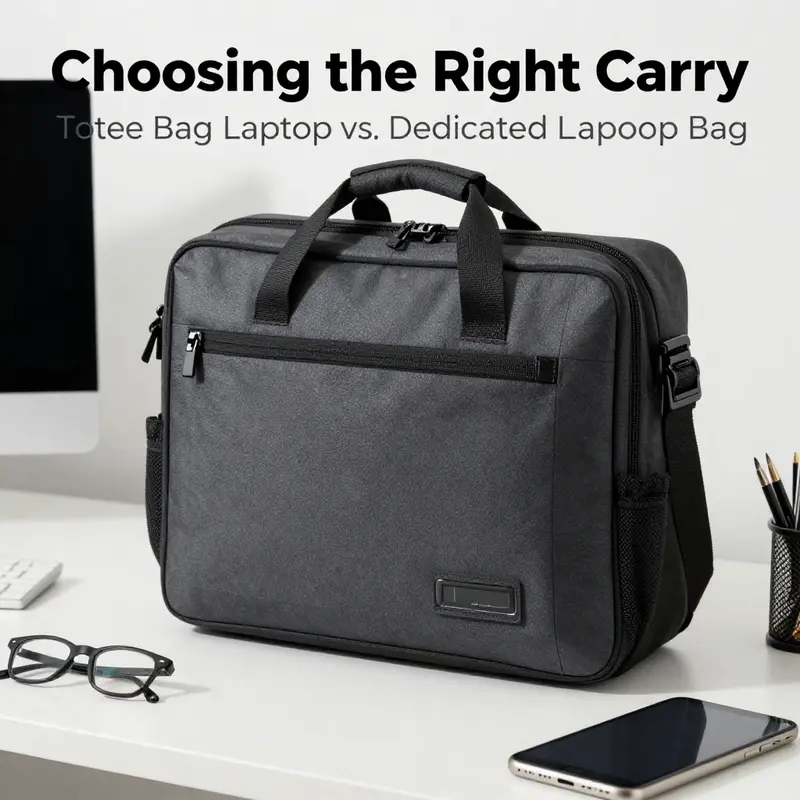
A bag that is designed to cradle a laptop does more than carry a device from point A to point B. It embodies a philosophy: protection first, practicality second. In the everyday dance of commutes, coffee spills, elevators, and crowded trains, a laptop faces risks that extend far beyond simple scratches. A dedicated laptop bag answers those risks with a singular focus on safeguarding the delicate core of your workflow. It is not merely a container; it is a carefully engineered system that blends materials science with user-centered design. The result is a protective envelope that remains pliant enough to carry comfortably yet firm enough to endure the rough edges of transit. When you compare this to a tote bag that includes a laptop sleeve, the distinction becomes clearer: the sleeve protects the edge of a single device, but the bag around it is often a low-cost shell that can compress or buckle under pressure. In a busy morning, when a bag is squeezed onto a crowded shelf or tucked beneath a seat and leaned on by a stray backpack, every millimeter of padding and every engineered feature matters. The dedicated bag treats the laptop as a purpose-built payload rather than a secondary concern, and that mindset translates into real-world longevity for the device it houses.
Every element inside a dedicated laptop bag is chosen to reduce the chance of a shock reaching the internal components. The corners, which absorb a disproportionate share of impacts, are typically reinforced with extra layers of protection. This reinforcement is not merely cosmetic. It is a deliberate engineering response to the common scenarios where devices meet hard surfaces: a dropped edge against a tile floor, a collision with a metal chair leg, or a bump while shuttling through a busy airport corridor. By hardening these vulnerable zones, manufacturers acknowledge that the path of a laptop during transit is unlikely to be perfectly smooth. The corner is where a drop ends, and if that moment is cushioned by fortifying materials, the risk of a cracked chassis or a popped hinge decreases significantly. The result is a bag that behaves like a small shield, not just a bag with a pocket.
A step beyond corner protection is the full-wrap padding that encases the laptop on all sides. This is where the conversation about comfort and safety converges. Padding in dedicated laptop bags is not merely for feel; it is a blend of thickness and density designed to dissipate energy. The padding works in layers: a soft outer layer to prevent scuffs, a mid-layer to distribute impact, and a denser inner layer that slows the momentum of a fall. In practice, if the bag is dropped, these layers work together to convert what could be a jarring impact into a less threatening transfer of energy. The objective is simple but powerful: to keep the laptop suspended within a cradle of cushioning so that it does not bear the full brunt of any sudden jolt against a hard surface.
Another critical component is the shock-absorbing foam at the core of the laptop compartment. High-density foam acts like a tiny airbag for the device. It absorbs and redirects energy away from the aluminum chassis and the delicate display. The effectiveness of this feature becomes evident in scenarios that many people encounter without thinking about it: a train car stumble, a stair-step misstep, or a curb that’s sharper than expected. The foam’s performance hinges on its ability to rebound and its uniformity across the entire base and sides of the laptop pocket. If the foam is inconsistent, a corner or edge may remain inadequately cushioned, creating a stress point that could become a hotspot for damage over time. When the foam is well-executed, even a relatively modest 1–2 centimeter thickness can translate into meaningful protection without adding excessive bulk or weight.
A structured internal frame is another hallmark of sophisticated design. Some bags incorporate a gentle internal skeleton that suspends the laptop, lifting it away from contact with the outer shell and any flat surface underneath. This can feel like a small luxury, but it serves a practical purpose. The frame maintains a stable position for the device, which is especially valuable when the bag is set down on an uneven surface or placed under a seat in a crowded venue. With the laptop suspended, the risk of edge damage or screen pressure from the bottom is reduced. The frame also helps keep cables and accessories neatly aligned, preventing them from pressing against the laptop lid and creating micro-depressions in the display over time. In essence, the laptop becomes a protected centerpiece, floating within a protective cocoon rather than resting on a potentially compromising layer of items.
Water resistance is not optional in today’s travel culture; it is a baseline expectation. A dedicated laptop bag often integrates a water-repellent exterior and tightly sealed zippers, so a spill or sudden rain does not become a catastrophe. The exterior materials are chosen for durability and weatherproofing, capable of shrugging off damp days without soaking through to the device. The zippers themselves are more than closures; they are design elements that keep moisture and dust out of the main compartment while also resisting snagging and catching. A well-executed closure system reduces the probability that moisture will seep into the sensitive electronics, an outcome that can become expensive and frustrating to repair.
Inside the bag, organizers are tailored to protect and separate. The dedicated laptop compartment is typically accompanied by internal dividers, small pockets for chargers, adapters, and cords, and sometimes even a separate, padded sleeve for a tablet or a secondary device. This level of organization matters during a busy day when you cannot waste precious minutes rummaging for a charging cable in a dim airport lounge. The internal layout is not an afterthought; it is a core part of the protection strategy. By keeping devices from shifting and banging against each other, the bag minimizes the micro-movements that can accumulate into micro-damages over time. The result is a system in which the laptop remains in a near-constant, secure position, reducing the probability that a single bump translates into a cumulative, invisible risk.
A structured interior often pairs with a robust external shell, giving the bag a balanced blend of rigidity and flexibility. This balance is essential for daily life, where bags bounce between overhead bins, car trunks, and office desks. Rigidity ensures that the bag maintains its protective envelope even when it is stuffed to the limit, while flexible panels allow for easier extraction of the laptop and comfortable shoulder or hand carry. The best designs use a lightweight frame or reinforced panels that do not add excessive weight, because a heavy bag defeats one of the principal purposes of a portable workstation. The right mix of rigidity and give makes for a bag that travels well without inadvertently transmitting more force to the device than necessary during a bump or drop.
Security features, while often associated with business travel, reinforce the protective ethos of a dedicated laptop bag. Lockable zippers and RFID-protected pockets add layers of practical protection, ensuring that the bag is not just resistant to physical damage but also resistant to theft and data compromise. While these features do not directly cushion the laptop, they support a broader mission: safeguarding valuable digital infrastructure in everyday environments. In a world where laptops can carry sensitive information or hold hours of work, these small, thoughtful touches reduce anxiety and enable more confident travel and commuting.
The practical implications of choosing a dedicated laptop bag over a tote with a sleeve extend into multiple dimensions of daily life. For one, the purposeful padding and frame design encourage better weight distribution. The weight of a laptop, plus the chargers and accessories commonly carried alongside it, can tax the shoulders and back if not managed properly. A bag that distributes weight across the back and side panels, with thoughtful strap geometry and padding at contact points, helps minimize fatigue and risk of repetitive strain. This is not just about comfort; it is about long-term health and sustained productivity. When a bag supports proper posture and reduces the likelihood of shoulder strain, it also reduces the chance of devices being dropped in a moment of fatigue. The protective system is therefore intimately linked to ergonomic outcomes.
The choice of materials matters at every level. The outer shell is often a careful compromise between toughness and weight. Materials with abrasion resistance stand up to the daily grind of cities, airports, and office corridors. Inside, the padding must resist compression and maintain its protective profile after repeated use. Over time, well-chosen materials retain their shape and cushioning properties better than cheaper alternatives. The result is a bag that continues to feel protective, even after months of commuting, travel, and occasional rough handling by others who assume a bag is simply a vessel for items rather than a precious shield for a device.
What does this protection mean in practical terms? It means that a dedicated laptop bag is a proactive investment in the device’s longevity. It translates to fewer repair visits, lower risk of screen damage, and less downtime waiting for a replacement if the worst happens on a journey. The relationship between bag construction and device safety is not abstract; it is a measurable difference that shows up when a bag is tested by real-world use. A traveler who relies on public transport, a remote worker who moves between coworking spaces, or a student who shuttles between classes all benefit from this design philosophy. The bag does not merely carry; it guards. It treats the laptop as a valuable tool that deserves a protective home, and that mindset changes how we experience every transit moment, from the rush of boarding to the quiet minutes of waiting for a delayed connection.
Choosing a dedicated laptop bag also invites reflection on what features are genuinely useful in daily life. While some designs emphasize sleek aesthetics, others prioritize modularity, add-on straps, or compatibility with luggage handles. The most successful examples manage to blend these attributes without compromising the core protective mission. A well-made bag might offer a trolley pass-through for airports, a water bottle pocket for long commutes, and a dedicated power brick pocket that keeps cords organized and easy to reach. These elements are not luxuries; they are part of the protective ecosystem that makes handling devices easier and safer under pressure. In practice, this translates into fewer rummaging moments at security checkpoints, more reliable access to essential peripherals, and a calmer sense of control when navigating busy environments.
In the end, the dedicated laptop bag is about intent. It communicates a clear decision: the laptop is worth protecting with purpose-built engineering. This is a contrast to bags that merely accommodate a laptop within a larger, multipurpose shell. The dedicated design speaks to the realities of modern work and life, where devices travel through crowded spaces, endure weather, and sit for long periods in unpredictable environments. The protection strategy is not a cosmetic feature; it is a core performance criterion. It is why a 1–2 centimeter padding standard, combined with weather-resistant materials and secure closures, remains a practical baseline for anyone who depends on a laptop for daily work. The chapter’s throughline is simple: better protection, smarter design, and a bag that anticipates the journey rather than merely bearing the luggage. When you adopt this approach, you are not choosing between fashion and function; you are choosing a more reliable, longer-lasting relationship with your technology.
For readers who want a practical path to upgrading their everyday carry, the narrative is not about chasing the latest flashy model. It is about recognizing the signals of thoughtful construction and translating them into a personal toolkit that stands up to your routine. Start with a bag that advertises its protection in the details: reinforced corners, comprehensive padding, a suspended laptop compartment, good sealing against moisture, and an interior layout that keeps cables and devices separate but accessible. If such features align with your daily rhythm, you have found a bag that does more than hold your device. It protects it, supports your work, and quietly makes every journey a little less risky. A dedicated laptop bag, in this sense, becomes a partner in your productivity—an ally that helps you focus on tasks rather than the fragility of the gear you rely on to get them done.
For readers curious about how this translates into everyday shopping, consider exploring options that emphasize protected compartments, test the feel of the padding, and examine how the bag behaves when you tilt, twist, or set it down with a laptop inside. The goal is not to find the lightest or the most fashionable option alone but to locate a companion that harmonizes protection with everyday practicality. This means a bag that feels sturdy yet remains comfortable to carry through a long day, a bag that keeps your screen clear and your cables orderly, and a bag that endures the rhythm of traveling between meetings, campuses, and homes. In that sense, the dedicated laptop bag becomes more than a bag—it becomes a responsible, enduring home for your digital life.
To connect this discussion with broader shopping considerations, you might explore related content on laptop-carry solutions that emphasize women-specific or work-focused contexts. For instance, you can explore laptop-tote-bags-women for a sense of how design continues to evolve to meet diverse user needs while maintaining a focus on protection and organization. The balance of form and function in these designs offers useful contrasts that help refine what you seek in a protective, travel-ready solution.
External reference for further reading on protective design principles and material considerations can be found at an external resource that discusses form, fit, and impact protection in modern laptop carriers. This helps contextualize how professionals think about risk assessment, material science, and ergonomics when selecting gear that travels as much as the work itself. [External resource link]
Internal link (for related reading within this article) can be directed to a guide exploring tote and bag options in broader categories, as a way to compare multipurpose bags with dedicated protective designs. See this section for a concise overview of how dedicated laptop bags differ from multipurpose totes, especially in terms of padding distribution, corner reinforcement, and internal suspension.
As you reflect on these principles, remember that protection is not a single feature but an ecosystem. The combination of reinforced corners, full-wrap padding, shock-absorbing foam, a structured frame, water resistance, organized interiors, and secure closures all work together to reduce the risk of damage across multiple travel scenarios. The result is a practical, reliable piece of equipment that supports your work rather than complicating it. When people ask why one should invest in a dedicated laptop bag, the answer often comes back to this holistic approach: it is a lightweight, purpose-built shield that travels with you, even when the road gets rough. And in the long arc of device longevity, that shield pays for itself many times over in peace of mind and uninterrupted productivity.
If you’re shopping with longevity in mind, consider how the bag performs after months of daily use. Does the padding compress unevenly? Do the corners still stay firm? Has the interior dividers’ structure held up to repeated unzipping and reorganization? A bag that continues to protect after heavy use demonstrates that protection is not a one-off feature but a sustained capability. This is the essence of the dedicated laptop bag: it remains protective across time, not just at the moment of purchase. The investment is not merely in a puffy sleeve or a fashionable silhouette; it is in a durable, well-considered architecture that respects the value of the device inside. When this architecture is present, the relationship between user and device shifts from cautious dragging to confident carrying, and that confidence translates into better performance, fewer disruptions, and a more seamless daily routine.
To summarize, a dedicated laptop bag delivers superior protection through a carefully layered approach: reinforced corners, full-wrap padding, shock-absorbing foam layers, and a structured interior frame. These features work together to suspend and cushion the laptop, preventing shock from reaching essential components during the inevitable bumps and drops of daily life. Water resistance and secure closures add practical resilience, while well-thought-out internal organization supports ease of use and reduces the risk of accidental damage from hurried packing. In short, the dedicated bag is built for the long haul, designed for people who rely on their devices every day and want to protect both the hardware and the work it enables. The choice is clear for frequent travelers, remote workers, and anyone who values long-term device safety: prioritize a dedicated laptop bag with ample padding, water resistance, and a secure closure, and let protection become a habit rather than a worry.
Internal link reference:
External resource: https://www.rains.com/zh-cn/products/16-inch-laptop-sleeve-for-macbook
From Sleeve to Shield: Weighing Protection, Portability, and Professionalism in Tote Bags with Laptop Sleeves versus Dedicated Laptop Bags

Carrying a laptop in the city, on a commute, or between meetings is more than a habit. It is a statement about how you value your work, your time, and the planet’s resources. The choice between a tote bag with a built-in laptop sleeve and a dedicated laptop bag is not a mere fashion decision; it is a judgment about risk, practicality, and personal comfort. The difference between these two options becomes especially vivid when you watch a device take a spill, or when you try to balance a full day’s gear on a crowded train. The narrative that emerges is not about trend vs. utility alone, but about how a bag supports or undermines the journey from idea to outcome. The research landscape suggests that protection is the most consequential axis, followed by how easily the bag keeps you organized, how it feels to wear it for hours, and how it registers in a professional setting. In that sense, the choice between a tote with a sleeve and a purpose-built laptop bag is a practical lens into the broader question of device longevity, daily efficiency, and personal style under pressure.
Protection stands at the center of the comparison. Dedicated laptop bags are engineered with a singular aim: to cushion the device from the kinds of bumps and compressive forces that occur in transit. They employ full-wrap padding and reinforced corners, often backed by a structured interior frame that suspends the laptop and keeps it away from hard edges. The materials chosen for these bags are not incidental; they are selected for shock absorption, weight distribution, and the ability to dampen impacts even when the bag is pressed from the outside by a backpack strap or a crowded shelf. In a typical scenario, the laptop sits within multiple layers of protection—padding layered against a rigid shell, then a secure closure that prevents sudden movement. This architecture reduces the risk of damaged display cables, misaligned ports, and the kind of deep dent that can compromise the chassis. The protective logic is straightforward: create a buffer between the device and the world, and the world loses a portion of its bite.
By contrast, a tote bag with a laptop sleeve tends to offer a thinner, more flexible layer of defense. The sleeve itself is designed to shield against scratches and minor scuffs, which is valuable, but it does not provide the same level of structural support. The interior padding in many sleeves is minimal, and it often covers only the faces of the laptop rather than the sides and corners. Without a robust internal frame or deep cushioning at the corners, the device remains more exposed to lateral impacts, compression from heavier items, and the jostling that accompanies a bus ride or a hasty elevator ride. This gap becomes visible in real-world tests that measure how much impact energy is absorbed by different bag constructions. When a laptop is dropped from a modest height or when it is pressed against a hard object, the lack of a protective cage can translate into higher risk of edge damage, screen pressure points, or misalignment of internal components.
The comparative terrain becomes even clearer when we consider water resistance and closure security. Dedicated laptop bags often come with weatherproof exteriors and secure closures that minimize exposure to rain, dust, and accidental zipping of loose items into the keyboard. Zippers are typically reinforced, and there may be internal dividers or independent pockets for chargers, cables, and accessories. The overall design emphasizes not just protection from physical shocks but also protection from the elements and from the clutter that can cause stress during a workday. A bag built around the laptop, after all, tends to be a more deliberate, methodical tool for organizing a day rather than a casual vessel for light daily use.
In contrast, the tote-with-sleeve model emphasizes versatility and aesthetics. It often blends into casual or semi-formal settings with ease, which can be a major plus for someone who moves fluidly between coffee shops, coworking spaces, and client meetings. But this versatility comes at a cost if your days routinely involve crowded commutes, long flights, or hours of movement between venues. The protective system is thinner, and the risk of compression from other items—especially when the bag is overfilled or placed under a seat or on a luggage rack—can be higher. The same portability that makes a tote appealing can, in certain contexts, magnify risk to the device. The upshot is that if your daily routine includes frequent travel, irregular storage conditions, or a demanding schedule of transitions, the dedicated laptop bag provides a more reliable shield for the device.
The practical implications of this protection calculus extend well beyond the moment of impact. A laptop that is well-protected is also more likely to experience less micro-movement inside its carrier, which in turn reduces wear on the hinges, battery, and internal components. When a device is jolted repeatedly during transit, micro-movements can accelerate wear and lead to subtle, cumulative damage over months and years. The structural integrity of a dedicated bag—its ability to keep the laptop anchored and separated from other items—acts as a safeguard for long-term device health. This isn’t a theoretical advantage; it translates into fewer screen calibrations, less risk of port damage from pressure, and a lower probability that a small drop becomes a permanent problem. The upshot is a longer useful life for the device, which carries a price in upfront cost but pays dividends in reliability and fewer repair bills down the line.
Practicality follows protection in importance, and here the story deepens. Dedicated laptop bags are infused with organizational intelligence. They offer multiple zipped compartments for slim tablets, charging bricks, cables, pens, notebooks, and even cooling pads, if you work in a heat-prone environment. Some models incorporate internal dividers that suspend the laptop and keep it from colliding with accessories; others may feature USB pass-throughs or external pockets designed for quick access. The emphasis is on workflow efficiency: you can reach for a charger without rummaging through loose items, you can find a pen without overturning a tote’s contents, and you can locate a passport or a document without exposing your laptop to a knock. The organization is not merely about ease; it is about preserving the integrity of the device by reducing the need to reposition or shuffle items, which can lead to accidental pressure on the laptop when you reconfigure your bag on a crowded train.
A tote with a laptop sleeve, while lighter on the weight of structure, can be surprisingly adaptable when used with discipline. It is possible to improvise a sensible organization system by placing the laptop in the sleeve first and then arranging other items around it, as a practical rule of thumb. Yet the design itself does not promote this habit; it relies on the user to maintain order and avoid stacking heavy items on top of the sleeve. A small but real tip emerges from experience: always place the laptop in the sleeve first, then organize other items around it—not on top—to reduce compression risk. This approach helps recover some of the protective advantage that a dedicated bag provides, but it cannot fully compensate for a lack of internal structure. For those who value simplicity and minimalism above all else, the tote-sleeve combination can be perfectly adequate in controlled environments, such as a daily office-to-meeting routine where the bag is not repeatedly subjected to rough handling.
Comfort and ergonomics shape the real-world experience of carrying these bags. The carrying experience is not a luxury; it is a determinant of daily fatigue and posture. Dedicated laptop bags, especially backpacks and dual-strap designs, are designed to distribute weight evenly. The weight stays closer to the body’s center of gravity, reducing shoulder strain and spinal torque. Even a well-balanced shoulder bag benefits from a design that keeps the weight supported rather than swinging away from you. In contrast, tote bags, once filled beyond a modest threshold, begin to swing and twist. They can pull on the arm, creating torque that concentrates stress on the neck and upper back. For long commutes or days spent moving between offices, the ergonomic profile of a bag matters. It is not purely about comfort in the moment; it is about how the bag interacts with your posture hour after hour. Ergonomic research regularly points to the importance of distributing weight across both shoulders and keeping the load near the chest or spine to minimize compensatory muscle activity. A tote that relies on a single handle or a single carrier often fails to achieve that balance, introducing subtle strains and a creeping sense of fatigue after a day of movement.
The broader professional picture also weighs heavily in the decision. In most corporate contexts, a dedicated laptop bag has become a conventionally accepted signal of preparedness and reliability. It communicates that you have a plan, that you respect others’ time, and that you are mindful of the practicalities of modern work life. In formal settings, a clean, structured, purpose-built bag tends to project a certain seriousness, clarity, and order. It is the kind of accessory that can slip into a client meeting or an interview with a sense of purpose. Meanwhile, there is a growing appeal for tote bags with laptop sleeves in business casual or creative environments. The minimalist aesthetic, the range of materials—from canvas to refined leather—offers a kind of visual flexibility that can harmonize with a broader wardrobe. The social perception, however, shifts by context. A tote with a sleeve might be seen as stylish and approachable in a startup setting, but in a high-security or highly formal environment, the same choice may be perceived as less traditional or less robust. A 2026 survey noted in business contexts that many executives prefer dedicated laptop bags for client-facing situations, citing reliability and image. That finding is not a verdict but a caution: the setting often dictates the most appropriate carrier.
The interplay of function and impression becomes even more nuanced when you consider the logistics of daily use. A dedicated laptop bag often accommodates a broader array of gear and accessories: tablets, chargers, cables, a notebook, a small cooling pad, a water bottle, and perhaps a compact umbrella. The internal diversity of pockets and dividers makes it easier to separate fragile items from heavier ones, reducing the chance of one item pressing against the laptop. For people who travel frequently, the structured interior acts as a protective scaffold, even when the bag is stored or stacked among other luggage. By comparison, a tote bag, even when well designed, invites a certain improvisation. The open or partially enclosed interior demands careful packing discipline. A spill of pens, an umbrella, or a power brick could shift the laptop’s alignment within the sleeve, especially if the bag is jostled in transit. This is not a condemnation of totes; rather, it is a reminder of the trade-offs that come with form and function. The practical takeaway is that the decision should align with your travel frequency, your risk tolerance, and your willingness to manage contents intentionally.
For readers who remain drawn to the tote aesthetic without sacrificing too much protection, there is a middle ground worth noting. A tote designed specifically for work with a padded laptop sleeve and a compressive inner layer can offer a balanced alternative. The design can feature reinforced corners, a snug interior, and weatherproof materials without becoming as bulky as some traditional laptop bags. It can provide an efficient compromise for people who want the elegance of a tote but also want to shield their device from routine shocks. The key, of course, is to ensure that the padding is substantial—ideally 1 to 2 centimeters at critical points—and that the exterior fabric resists moisture and abrasion. The goal is to answer the question of whether one can enjoy style and convenience without surrendering protection. The answer, as the evidence suggests, is that it is possible but requires deliberate design choices and disciplined packing habits.
In light of these considerations, the final verdict should reflect context and risk tolerance. If your days are spent largely in controlled environments, and you value a certain fashion sensibility, a well-constructed tote with a padded laptop sleeve can be a satisfying option. It preserves ease of access, reduces weight, and offers a flexible silhouette that pairs well with casual and semi-formal outfits. If your work involves frequent travel, irregular storage, or a high likelihood of abrupt movements—on buses, trains, or crowded events—the protective advantage of a dedicated laptop bag becomes compelling. The difference is not merely an extra centimeter of padding; it is the presence of a dedicated internal frame, reinforced corners, and a design that prioritizes your device’s structural safety while also supporting your daily itinerary. The equation is friendly to both sides until the context shifts toward higher risk; then the dedicated option tends to pull ahead in practical protection, organization, and ergonomic comfort.
For readers seeking a concrete starting point, the literature suggests that upgrading to a dedicated bag with measurable padding and weather resistance offers tangible benefits for device longevity and user well-being. It is not merely about resisting drops; it is about resisting the cumulative wear of everyday life—the pressure from a heavy laptop pressed against a sleeve, the subtle shifts from a crowded commuter train, or the moisture exchange that comes with unpredictable weather. The decision is also about a personal standard: are you content to accept occasional discomfort and content management that relies on guesswork, or do you prefer a rigorously designed carrier that reduces risk and supports your workflow? In the end, the choice should align with how you work, how often you travel, and how much you value long-term device health. The evidence tilts toward the dedicated laptop bag for those who prioritize protection, organization, and ergonomic steadiness, while acknowledging that a thoughtfully curated tote with a padded sleeve can serve well in compatible settings where risk remains low and style remains high. For readers who want to explore a tote option that emphasizes a protective sleeve, a dedicated page exists that discusses the interplay of sleeve design within the broader tote ecosystem. tote-bag-with-computer-sleeve
As you move toward a decision, consider the following synthesis: if your life weighs more on impulse decisions and quick style adjustments, and your risk profile includes minimal exposure to impact, a tote with the sleeve can be a reasonable daily carrier. If your life includes frequent travel, heavy payloads, unpredictable storage, or a commitment to long-term device health, a dedicated laptop bag offers a clearer protective envelope and a more robust ergonomic profile. The nuanced takeaway is that protection is the anchor, practicality follows, comfort completes the picture, and professionalism remains the stake you stake in your professional image. The research landscape confirms what experience has long shown: protection matters, organization matters, and comfort matters, all while style and image influence how others perceive your preparedness. As you weigh these dimensions, remember that the goal is not to crown one bag as universally superior but to find the right fit for your days. A thoughtful approach combines the best elements of both worlds: principled protection with flexible organization and a professional stance that matches your work environment.
External reference for further reading supports the practical insights above. Real-world tests and expert reviews consistently demonstrate that dedicated laptop bags deliver superior impact absorption and structural protection compared with tote sleeves, even when the latter includes a padded sleeve. You can access a comprehensive external evaluation of laptop bag protection that highlights the performance gap in controlled drop tests and real-world scenarios, which aligns with the conclusions drawn here. For readers who prefer a deeper dive into empirical results, this external resource provides an evidence-based perspective on how different bag designs perform under stress during transit. https://www.cnet.com/tech/gadgets/best-laptop-bags-for-protection-2026/
In closing, the journey from sleeve to shield is not simply about choosing between two bag types. It is about aligning your daily habits, travel footprint, and professional expectations with a carrier that can keep your device safe, your items organized, and your body comfortable. The landscape is nuanced, and the best choice depends on the rhythm of your work life. The tote with a padded sleeve offers elegance and lightness for low-risk settings, while the dedicated laptop bag delivers a robust, practical shield for high-frequency travelers and anyone who places a premium on long-term device health. The decision is personal, but the framework is clear: prioritize protection and ergonomics, weigh practicality and organization, and consider how your bag projects your professional stance in the rooms you enter. In that balance, you find not just a carrier for a device, but a reliable partner for your workday journeys.
Final thoughts
The choice between a tote bag with a laptop sleeve and a dedicated laptop bag is crucial for business owners who wish to safeguard their investment in technology. While tote bags provide stylish convenience, their protective limitations may put laptops at risk during travel. On the other hand, dedicated laptop bags offer superior protection, structural integrity, and additional features tailored for frequent travelers and remote workers. Ultimately, understanding these differences will empower you to choose the best option for your unique business environment, ensuring your device stays safe and functional.